

Choosing a Smart Ceiling Light is no longer a simple matter of selecting brightness and style. Global buyers must compare electrical compatibility, wireless standards, color quality, privacy controls, and long-term support. A fixture that works perfectly in London may fail in a home using different voltage, frequency, or smart-home platforms.
Dr. Mariana Figueiro, a recognized lighting and circadian-health researcher, has stated, “Light is a powerful biological stimulus.” That reminder changes the buying process. A bedroom may need warm, dimmable light at night, while a kitchen benefits from higher brightness and accurate color rendering. Check lumens, color temperature, CRI, dimming range, and the actual room size. Numbers matter.
Compatibility matters too. Look for verified support for Wi-Fi, Bluetooth, Matter, Alexa, Google Home, or Apple Home, depending on your setup. Confirm whether the product requires a hub. Read the privacy policy. Review firmware support and warranty coverage in your country. Safety certifications should match the destination market, not merely the seller’s claims.
Real installation details deserve attention. Measure the ceiling box, photograph the wiring, and confirm whether a neutral wire is required. Some lights feel intelligent but offer weak apps or unreliable schedules. That can become frustrating quickly.
A perfect choice is rare. Even experts must reconsider budget, aesthetics, maintenance, and data security. These ten buying tips provide a practical framework for comparing products honestly, avoiding attractive specifications that do not fit your room, electrical system, or daily habits.
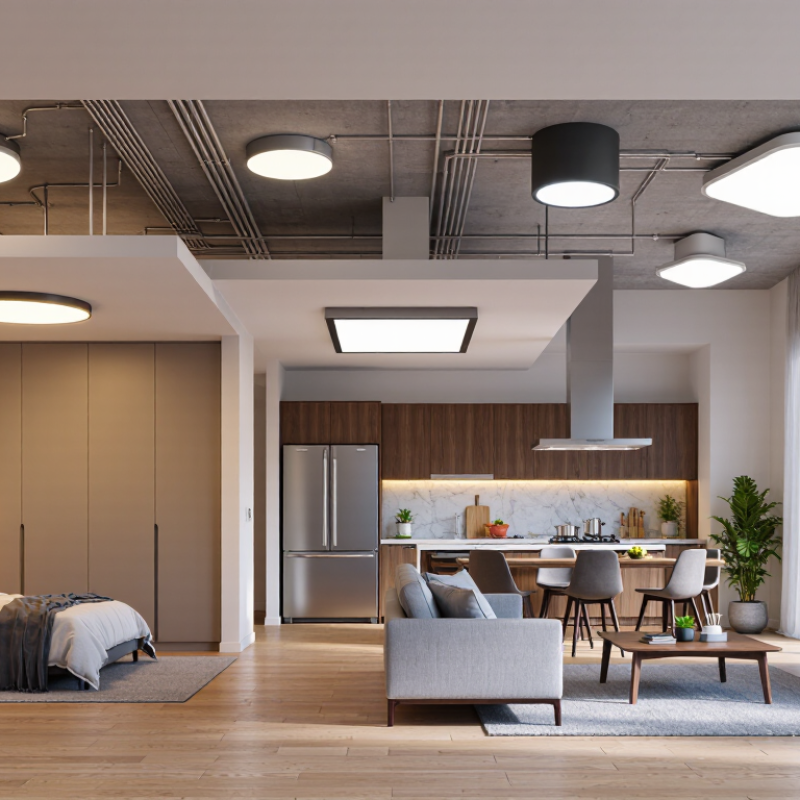
Define the room before comparing smart ceiling lights. In a narrow bedroom, soft, dimmable light can reduce glare and support restful evenings. A kitchen needs brighter, even illumination over counters and sinks. Measure the room and ceiling height carefully. A large fixture may overwhelm a low ceiling. Bathrooms require suitable moisture protection and secure installation.
Lighting goals matter as much as appearance. Warm light can create a relaxed atmosphere, while neutral light helps with cooking, reading, and cleaning. Check lumen output, color rendering, dimming range, and beam spread. A high lumen rating does not guarantee comfortable light.
Smart home compatibility deserves equal attention. Confirm wireless standards, app requirements, voice control support, and hub dependency before purchase. Check whether the light still works manually when the network fails. Global buyers should also verify voltage, frequency, plug or wiring requirements, and local installation practices. Some products appear universal but lack complete regional support. Firmware updates can improve reliability, yet they may interrupt routines temporarily. I prefer clear manuals, transparent data policies, and responsive technical support. These details often matter more than decorative features.

A smart ceiling light is useful only when its connection fits your home and daily habits. Check whether it uses Wi-Fi, Bluetooth Mesh, Zigbee, Thread, or multiple protocols. Wi-Fi usually needs a stable 2.4 GHz signal. Crowded apartments can expose weak coverage quickly. Bluetooth Mesh suits local control, but phone-only setups may feel limited across larger homes. Thread and Matter can improve interoperability, yet compatible hubs and firmware remain essential. Do not assume “works with” means every feature works everywhere. That is a common mistake.
Test the controls before buying. A reliable wall switch, remote, and power recovery setting can prevent frustration when internet access fails. Keep voice control optional, because microphones and cloud services may raise privacy concerns. Look for encrypted communication, signed firmware updates, and a clear support policy. For international use, confirm regional voltage, wireless frequency rules, language support, and app availability. I once underestimated app localization; a well-designed fixture became awkward when settings remained untranslated. Small detail.
Automation should respond to real conditions, not create constant surprises. Choose scheduling, occupancy sensing, daylight adjustment, and gradual dimming when they suit your rooms. A hallway might need motion activation for two minutes, while a bedroom needs quiet, low-level lighting. Check whether automations run locally or depend on a remote server. Local routines usually respond faster during outages, but setup can be less intuitive. Review permissions and test failure scenarios before installing several units. The cleverest system is not always the easiest to live with.
When evaluating a ceiling light, start with lumens rather than watts. Lumens measure visible brightness, while watts measure energy input. A high lumen number can still disappoint if the diffuser creates glare or uneven shadows. The U.S. Department of Energy advises comparing LED efficiency in lumens per watt. In practical checks, read the beam spread and diffuser material, not only the package headline. Measure the room, too. Oversizing wastes energy.
Color quality deserves equal attention. Color temperature affects comfort: warm white suits bedrooms, while neutral or cooler light often supports kitchens and work areas. Color Rendering Index, or CRI, ranges from 0 to 100. The U.S. Department of Energy identifies 80-plus as generally acceptable, while 90-plus is preferable for textiles, food, and artwork. Still, CRI is incomplete. It may not reveal poor red rendering or unpleasant green tones. Request test data based on recognized photometric methods.
Energy use and lifespan should be judged together. The U.S. Department of Energy reports that efficient LED lighting can use at least 75% less energy and last up to 25 times longer than incandescent lighting. However, advertised lifetime can hide thermal problems. Check rated life, warranty terms, operating temperature, and lumen maintenance data. Standards such as LM-80 and TM-21 help evaluate LED depreciation, but they do not guarantee every installed fixture will perform identically. Real rooms are less controlled. Dust, heat, voltage variation, and frequent switching still matter.
Compare typical ceiling-light specifications by application to evaluate brightness, color quality, energy use, and product lifespan before purchasing.
Practical benchmarks: bedrooms commonly use about 1,000–2,000 lumens, living areas about 2,000–3,000 lumens, and kitchens or work areas about 3,000–5,000 lumens. A CRI of 80+ is suitable for general lighting, while 90+ provides better color rendering. LED ceiling lights commonly deliver approximately 80–120 lumens per watt and are often rated for 25,000–50,000 hours.
10 Smart Ceiling Light Buying Tips for Global Buyers
Verify Safety Certifications, Voltage Support, and Regional Compliance
A ceiling light is not globally compatible because its socket fits. Check the input range, frequency, wiring method, and installation environment before approving samples. A 100–240 V, 50/60 Hz driver usually offers broader coverage, but the product still needs local testing. Confirm whether the ceiling box, earth connection, and terminal design match regional practice.
Ask for the complete certificate, not only a printed logo. IEC 60598-1 provides core safety requirements for luminaires, including insulation, temperature, and mechanical protection. In the European Economic Area, applicable products may also require Low Voltage Directive 2014/35/EU compliance and a valid Declaration of Conformity. Certification databases and certificate numbers deserve more trust than attractive packaging. Logos can be copied.
Energy performance matters too. The International Energy Agency reports that lighting uses about 15% of global electricity. Efficient products can reduce operating costs, but claimed wattage and lifetime should come from test reports. Check photometric files, power-factor data, and testing standards. A very long lifetime claim may hide harsh conditions or optimistic assumptions. I once focused too heavily on brightness and overlooked driver heat. That was a costly reminder. Compliance is never a single document; it is a chain of evidence connecting the lamp, driver, factory, and destination market.
Before buying a smart ceiling light, inspect the installation requirements carefully. Measure the ceiling box, wire positions, and available clearance. A heavy fixture may need stronger support than an existing fitting provides. In older homes, wiring colors can be confusing. Ask a qualified electrician when instructions are unclear. A simple installation is not always the safest one.
Tip: Check the warranty in practical terms. Confirm its length, covered parts, replacement process, and shipping responsibility. Some warranties exclude installation damage or moisture exposure. Keep the receipt, photos, and installation date in one folder. I have seen buyers lose valid claims because these details were missing. Small paperwork matters.
App support can shape daily ownership more than brightness. Check whether the app supports your phone, local language, and stable account recovery. Review update history and privacy information before connecting the light. Also test whether basic controls work without the app. Internet failures happen. They are inconvenient, not theoretical. Calculate the total cost, including electrician fees, compatible switches, electricity use, subscriptions, and possible replacement parts. A low purchase price can become expensive after two years. My own buying process is still imperfect; I sometimes underestimate labor costs. That is a useful warning when comparing international offers.
| No. | Buying Dimension | What to Check | Practical Benchmark or Requirement | Why It Matters | Ownership-Cost Impact | Priority |
|---|---|---|---|---|---|---|
| 1 | Room Size and Light Output | Compare the fixture's delivered lumens with the room area and use. | Use approximately 100–200 lumens per square metre for general residential lighting. Choose a higher level for kitchens, work areas, or rooms with dark finishes. | A suitable lumen level reduces glare, under-lighting, and the need to add extra fixtures. | Correct sizing can reduce the cost of additional lamps, rewiring, and later replacement. | High |
| 2 | Ceiling and Electrical Compatibility | Check ceiling material, mounting surface, junction-box position, fixture weight, voltage, frequency, and included hardware. | Confirm compatibility with the local electrical system before purchase. Hardwired installations should be completed by a qualified electrician where required by local law. | Electrical standards and ceiling construction differ between countries, and unsuitable hardware can create safety risks. | Correct compatibility helps avoid adapters, replacement drivers, return shipping, and extra installation visits. | High |
| 3 | Installation Difficulty | Review fixture dimensions, mounting method, cable access, installation instructions, and whether a second person is needed. | Prefer clear diagrams, labelled terminals, secure mounting brackets, and all required screws or anchors. Do not rely on product photographs alone. | A simpler installation reduces labour time and the chance of incorrect wiring or ceiling damage. | Include electrician labour, travel charges, ceiling repairs, and disposal of the old fixture in the installation budget. | High |
| 4 | Energy Consumption | Record rated wattage, expected daily operating time, and local electricity price. | Estimate annual energy use with: watts ÷ 1,000 × operating hours per day × 365. Multiply the result by the local electricity tariff. | Lower wattage at the same useful light output generally reduces operating emissions and electricity use. | Total energy cost should be calculated over the expected service period, not only from the purchase price. | High |
| 5 | Light Quality and Dimming | Check colour temperature, colour rendering, flicker performance, dimming method, and compatibility with existing controls. | For general living areas, 2700–3000 K is commonly perceived as warm; 3500–4000 K is commonly used for neutral task lighting. Look for a stated CRI value and verified dimmer compatibility. | Light quality affects comfort, colour appearance, productivity, and the usability of connected controls. | Compatible dimming can prevent the cost of replacing switches or buying separate control equipment. | Medium |
| 6 | Smart-Home and App Support | Check supported operating systems, wireless standard, required hub, account requirements, privacy policy, firmware updates, and offline operation. | Confirm that the app is available in the buyer's country and language. Verify whether basic on/off control works when internet access is unavailable. | Regional app restrictions, cloud dependence, and discontinued software can reduce functionality even when the hardware still works. | Consider hub fees, subscription charges, mobile data use, replacement controllers, and future support limitations. | Medium |
| 7 | Warranty and Returns | Read warranty duration, covered components, exclusions, proof-of-purchase rules, return window, and who pays return shipping. | Separate the warranty for the fixture from coverage for the LED module, driver, remote, and smart-control components. Keep invoices and installation records. | Different parts may fail at different times, and some warranties exclude incorrect installation or moisture exposure. | Short or unclear coverage can shift replacement, shipping, labour, and disposal costs to the buyer. | High |
| 8 | Durability and Serviceability | Check rated operating life, driver quality information, heat management, ingress protection rating, and availability of replacement parts. | For damp locations, select a fixture with an ingress protection rating appropriate to the installation area. Do not treat an indoor-only fixture as suitable for outdoor use. | Heat, moisture, dust, and inaccessible components can shorten service life and increase failure risk. | Replaceable drivers, remotes, or LED modules may cost more initially but can reduce full-fixture replacement costs. | High |
| 9 | Shipping, Taxes, and Regional Compliance | Calculate product price, international freight, customs duty, VAT or sales tax, brokerage fees, and local recycling obligations. | Use the delivered cost to the installation address rather than the advertised item price. Check whether the product has the electrical conformity markings required in the destination market. | A low purchase price can become expensive after import charges or may not meet local safety requirements. | Include customs delays, damaged-goods claims, cross-border return shipping, and local disposal fees. | High |
| 10 | Total Cost of Ownership | Combine purchase, delivery, taxes, installation, electricity, maintenance, subscriptions, repairs, and replacement costs. | Use: Total ownership cost = delivered purchase cost + installation + energy + maintenance and subscriptions + expected repair or replacement cost − valid rebates. | This provides a fair comparison between inexpensive basic fixtures and higher-priced connected models. | Compare costs over the same period, such as five years, and use the same operating hours and electricity tariff for every option. | High |